

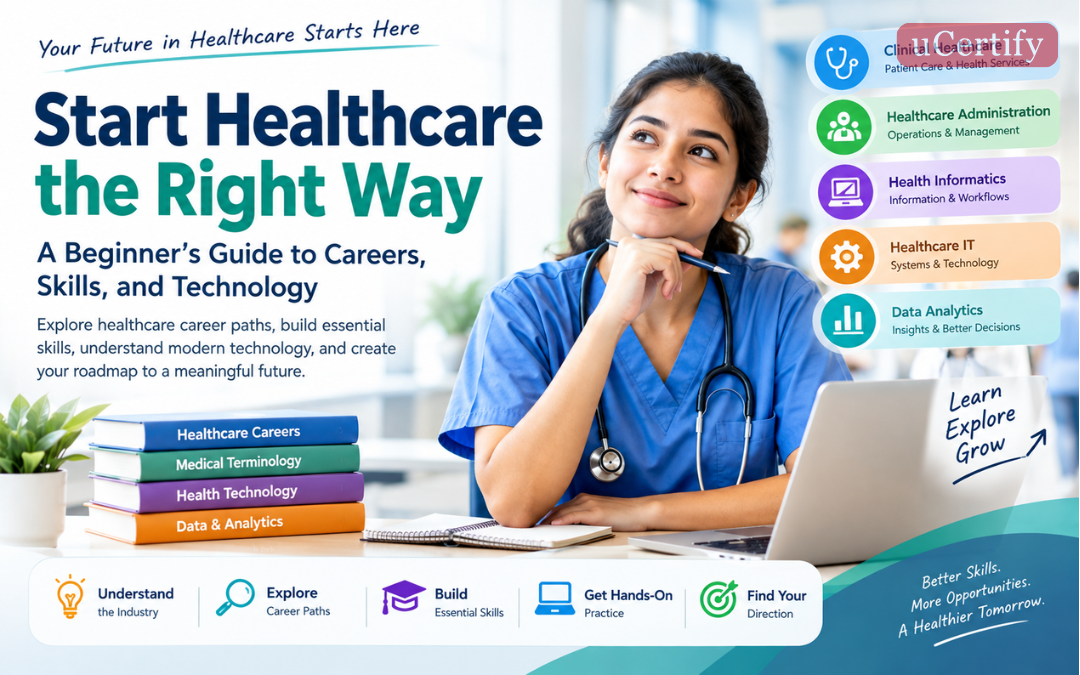
Start Healthcare the Right Way:
When people hear the word healthcare, they often picture a doctor examining a patient or a nurse working on a hospital floor. That is certainly part of the industry, but it is only one part.
A modern healthcare organization is more like a large team. Clinicians care for patients, administrators keep operations moving, technology professionals support digital systems, analysts work with data, and information specialists help ensure that health information can be recorded, accessed, and used properly.
That is why healthcare can feel confusing to someone just starting out. There are many career paths, and they do not all require the same interests, education, or skills.
You might want to work directly with patients. You might be more comfortable working with computers and systems. Perhaps numbers and data interest you more than clinical work. Or maybe you like organizing people, processes, and resources.
You do not need to make that decision on day one.
A better starting point is to understand what healthcare includes, what different professionals actually do, and which type of work fits you best.
This guide will help you build that foundation and create a practical path forward.
By the end of this guide, you should be able to:
- Explain the major areas of the healthcare industry.
- Distinguish clinical, administrative, technology, informatics, and analytics roles.
- Identify healthcare career paths that match different interests.
- Understand the foundational skills beginners should develop.
- Create a simple learning plan before choosing a specialization.
What Is Healthcare?
Healthcare is the broad system of services, professionals, organizations, information, and technologies involved in maintaining and improving people’s health.
It includes far more than diagnosis and treatment.
Depending on the setting, healthcare can involve:
- Preventive care
- Diagnosis and treatment
- Emergency services
- Nursing and patient care
- Medical laboratories
- Pharmacy services
- Rehabilitation
- Mental and behavioral health
- Healthcare administration
- Health information management
- Electronic health records
- Healthcare technology
- Health data analytics
- Medical research
- Public health
Consider what happens during a routine hospital visit.
A patient may first provide personal and insurance information at registration. A clinician then reviews the patient’s history and symptoms. If testing is required, laboratory or imaging professionals may become involved. The results have to be recorded, communicated, and interpreted. Administrative staff may coordinate appointments and billing, while digital systems help store and move information throughout the process.
The patient sees only part of this chain.
That is an important idea for anyone beginning a healthcare career: healthcare is an ecosystem, not a single job.
Once you understand that, the number of career options becomes easier to understand.
Why Choose Healthcare as a Career?
Healthcare attracts people for different reasons. Some want a patient-facing career, while others are interested in science, technology, business, research, or data.
One of the strongest advantages of the industry is its variety.
A wide range of career options
A person who enjoys biology and direct interaction with people may be drawn toward a clinical profession. Someone who prefers organization and business may find healthcare administration more suitable.
A technology-focused learner might explore healthcare IT or health informatics. Someone who enjoys working with numbers and finding patterns could investigate healthcare data analytics.
The point is not to find the “best” healthcare career.
It is to find the kind of problems you want to solve.
A clinician may solve patient-care problems. An administrator may solve operational problems. An IT professional may solve technology problems. An informatics specialist may improve how information moves through a healthcare workflow. An analyst may use data to help an organization make better decisions.
That perspective can make career selection much easier.
Technology is changing healthcare
Healthcare increasingly depends on digital systems, including healthcare app development to support patient services.
Electronic health records, telehealth, medical devices, data analytics, artificial intelligence, and other digital tools are now part of many healthcare environments.
This does not mean every healthcare professional needs to become a programmer.
It does mean that digital literacy is becoming useful across a growing number of roles.
Different education pathways
Healthcare education varies widely.
Some professions require extensive professional education and practical training. Other positions may be accessible through certificates, associate degrees, bachelor’s programs, specialized training, or technical education.
The important step is to investigate the requirements before choosing an educational program.
A job title alone does not tell you what qualifications you will need.
Major Healthcare Career Paths for Beginners
Before choosing a certification or degree, it helps to understand what the major healthcare career areas actually involve.
1. Clinical Healthcare
Clinical healthcare involves direct patient care and health-related services.
Examples include:
- Physicians
- Nurses
- Medical assistants
- Radiologic technologists
- Respiratory therapists
- Physical therapists
- Occupational therapists
- Dental professionals
These roles can differ greatly in responsibilities and education requirements, but they share a focus on patient care.
What might the work look like?
A clinical professional may communicate with a patient, collect or review relevant information, assist with procedures, monitor a patient’s condition, or contribute to a treatment plan, depending on the profession.
This path may suit someone who enjoys science, communication, problem-solving, and working directly with people.
Ask yourself: Would I rather spend much of my working day interacting with patients than working primarily with systems or data?
If the answer is yes, clinical careers may deserve closer attention.
2. Healthcare Administration
Healthcare does not run on clinical work alone.
Hospitals, clinics, and medical offices also need people who coordinate operations and keep processes organized.
Healthcare administration can involve:
- Hospital operations
- Medical office management
- Scheduling
- Healthcare finance
- Staffing
- Human resources
- Compliance
- Quality management
- Patient services
A practical example
Imagine a clinic where patients regularly wait too long before their appointments.
The problem may not be medical. It could involve scheduling, staffing, registration, communication, or workflow.
An administrator may examine the process, identify where delays occur, coordinate with different teams, and help improve the workflow.
This type of work can suit people who enjoy organization, communication, leadership, business, and process improvement.
3. Health Informatics
Health informatics sits at the intersection of healthcare, information, and technology.
It focuses on how health information is collected, organized, managed, exchanged, and used to support healthcare processes and decisions.
Professionals in this area may work with:
- Electronic health records
- Healthcare databases
- Clinical information systems
- Patient information
- Data quality
- Healthcare workflows
- Information security
- Healthcare analytics
A practical example
Suppose information entered during one part of a patient’s healthcare journey is difficult for another department to access or interpret.
An informatics professional may study the workflow and information requirements, work with relevant teams, and help improve how the system handles that information.
That is different from simply repairing a computer.
If you enjoy both healthcare and information systems, health informatics can be an interesting middle ground.
4. Healthcare Information Technology
Healthcare IT focuses more directly on the technology infrastructure and systems that healthcare organizations depend on.
Depending on the position, professionals may support:
- Hospital information systems
- Computer networks
- Electronic health record systems
- Medical software
- User accounts
- Data infrastructure
- Cybersecurity systems
- Technical support
A practical example
Imagine a healthcare employee cannot access an important system because of an account or technical problem.
An IT professional may investigate the issue, determine whether it involves the user’s device, account, network, or application, and work toward restoring access.
Healthcare IT therefore combines technical problem-solving with an understanding of the healthcare environment.
Health Informatics vs. Healthcare IT
These fields overlap, but they are not identical.
| Area | Main Focus | Typical Problem |
| Health Informatics | Health information and workflows | How can healthcare information be captured, managed, or used more effectively? |
| Healthcare IT | Technology systems and infrastructure | How can systems, devices, networks, and applications work reliably? |
A beginner who enjoys information and healthcare workflows may lean toward informatics, while someone who enjoys systems, troubleshooting, and technology infrastructure may prefer healthcare IT.
5. Healthcare Data Analytics
Healthcare generates large amounts of information through patient records, laboratory results, operations, financial activity, research, and population-health programs.
Healthcare data analytics focuses on turning that information into useful findings.
Common skills may include:
- Spreadsheet analysis
- SQL
- Statistics
- Data visualization
- Database concepts
- Reporting
- Data interpretation
Advanced roles may also use Python, R, machine learning, or specialized analytics platforms.
A practical example
Imagine a hospital notices that appointment cancellations are higher during certain periods.
An analyst could examine historical data, compare patterns, organize the findings into reports or visualizations, and help decision-makers understand what may be happening.
The analyst is not simply “working with numbers.”
The real goal is to use data to answer a healthcare question.
That distinction is important for beginners.
Healthcare Technology Every Beginner Should Understand
You do not need to become a technology expert before entering healthcare. However, understanding a few major concepts can make the industry easier to navigate.
Electronic Health Records
An Electronic Health Record (EHR) is a digital record containing information about a patient’s healthcare.
Depending on the system and organization, information can include:
- Patient demographics
- Medical history
- Diagnoses
- Medications
- Allergies
- Laboratory results
- Clinical notes
- Treatment information
For a beginner, the important point is not to memorize every EHR feature.
Understand the bigger picture: healthcare professionals need reliable information at the right time, and digital systems help organizations manage that information.
EHR knowledge can become especially relevant to healthcare IT, health informatics, administration, clinical work, and analytics.
Telehealth
Telehealth uses digital communication technologies to support healthcare services.
A simple example is a patient attending a healthcare appointment through a video consultation rather than visiting a clinic physically.
Telehealth connects healthcare with communication technology, but it also introduces practical considerations involving access, privacy, technology, workflows, and patient experience.
For beginners, it is useful to see telehealth not simply as “video appointments,” but as another example of how technology can change the way healthcare services are delivered.
Artificial Intelligence in Healthcare
Artificial intelligence is increasingly being explored and used across different areas of healthcare.
Potential applications include:
- Medical image analysis
- Clinical decision support
- Administrative automation
- Patient communication
- Drug discovery
- Healthcare research
- Data analysis
However, healthcare is not an environment where technology can simply be accepted without questions.
AI-related healthcare work can involve concerns about:
- Accuracy
- Bias
- Privacy
- Security
- Safety
- Human oversight
For a beginner, the most useful lesson is this:
Understanding healthcare fundamentals should come before trying to understand every new AI tool.
Technology is valuable when it solves a real problem. Knowing the problem comes first.
Essential Healthcare Skills for Beginners
A beginner does not need to master every skill at once.
Start with a small foundation and build from there.
1. Communication
Healthcare is highly collaborative.
Professionals may communicate with patients, families, clinicians, administrators, technicians, and other specialists.
Clear communication matters because even a technically correct decision can cause problems if information is misunderstood or poorly communicated.
2. Basic Medical Terminology
Medical terminology can look complicated when you first encounter it.
You will see terms related to:
- Anatomy
- Body systems
- Diseases
- Symptoms
- Procedures
- Treatments
- Medications
Instead of trying to memorize hundreds of words, learn common prefixes, suffixes, and root words.
Then use the terminology in context.
For example, learning a term while studying a particular body system is often easier than memorizing a disconnected vocabulary list.
3. Healthcare Ethics
Healthcare professionals regularly deal with sensitive information and situations.
Beginners should become familiar with concepts such as:
- Patient privacy
- Confidentiality
- Informed consent
- Professional responsibility
- Respect for patients
- Ethical decision-making
Ethics becomes much easier to understand when connected to real situations.
For example, consider a situation where someone has access to patient information but does not need that information to perform their job. Understanding confidentiality helps explain why access to healthcare data must be handled responsibly.
4. Digital Literacy
Basic computer skills are useful across many healthcare careers.
Depending on your specialization, you may eventually work with:
- EHR systems
- Databases
- Spreadsheets
- Healthcare software
- Data security
- Digital communication tools
You do not need to learn SQL, Python, networking, and database administration on your first day.
Choose tools based on the career path you eventually select.
5. Critical Thinking
Healthcare problems are rarely identical.
Professionals need to evaluate information, identify relevant details, recognize problems, consider possible solutions, and make decisions appropriate to their role.
You can practice critical thinking even before entering a healthcare job.
Take a simple case study and ask:
What is happening? What information is missing? What are the possible explanations? What would I need to know before making a decision?
That habit can be useful across clinical, administrative, technical, and analytical careers.
How to Start a Career in Healthcare: A Practical Roadmap
If you are wondering how to start a career in healthcare, resist the temptation to choose a job title immediately.
Start with a process.
Step 1: Identify the type of work you enjoy
Ask yourself:
- Do I want direct patient interaction?
- Do I enjoy science?
- Do I prefer computers and technology?
- Do numbers and patterns interest me?
- Do I enjoy organization and management?
- Would I prefer research or laboratory work?
- Do I like troubleshooting technical problems?
Your answers will not choose a career for you, but they can narrow the field.
Step 2: Compare careers by the work they involve
Don’t stop at the job title.
For each career, find out:
- What does the person do during a normal workday?
- Who do they work with?
- What problems do they solve?
- What education is required?
- What skills are expected?
- What kind of workplace do they work in?
This is a better way to evaluate a career than simply looking at a list of job titles.
Step 3: Verify education and credential requirements
Healthcare requirements vary significantly by profession and location.
Before enrolling in a program, check:
- Required education
- Practical training
- Certification requirements
- Licensing requirements
- Employer expectations
- Career progression
Use the relevant professional or regulatory organization when checking requirements.
Do not rely on a generic career article to determine whether a specific profession requires a license.
Step 4: Build your foundation
A useful learning sequence is:
Healthcare fundamentals → Medical terminology → Healthcare systems → Digital literacy → Specialization
This prevents a common beginner problem: learning an advanced tool without understanding the environment in which it will be used.
Step 5: Practice instead of only reading
Reading gives you concepts. Practice shows you how those concepts behave in a real situation.
Try:
- Case studies
- Simulations
- Virtual labs
- Healthcare software practice
- Data exercises
- Scenario-based activities
- Small projects
For example, someone interested in health informatics could practice with a simulated patient-record workflow and think about how information is entered, retrieved, and shared.
Someone exploring healthcare analytics could work with a sample dataset and answer a simple question using spreadsheets or SQL.
The project does not need to be complicated. It needs to make you use what you learned.
A 30-Day Beginner Plan for Healthcare
If you are starting from zero, you can turn the roadmap into a simple month-long plan.
Week 1: Understand the Industry
Learn:
- What healthcare includes
- Major healthcare settings
- Clinical vs. non-clinical careers
- Basic medical terminology
- How healthcare teams work
End-of-week task: Write down three healthcare careers that interest you and why.
Week 2: Explore Career Paths
Research:
- Clinical healthcare
- Healthcare administration
- Health informatics
- Healthcare IT
- Healthcare data analytics
End-of-week task: Compare the five areas by responsibilities, skills, and education requirements.
Week 3: Choose a Direction
Select one area for deeper exploration.
For example:
Health informatics: Learn about EHRs, healthcare workflows, databases, and information management.
Healthcare IT: Study basic networking, systems, troubleshooting, security, and healthcare applications.
Healthcare analytics: Start with spreadsheets, statistics, visualization, and SQL.
Administration: Explore healthcare operations, scheduling, communication, finance, and compliance.
Week 4: Build Something Practical
Complete one small hands-on activity.
Examples:
- Analyze a sample healthcare dataset.
- Create a simple healthcare workflow diagram.
- Practice navigating a simulated EHR environment.
- Build a basic data report.
- Complete a healthcare case study.
- Create a short presentation explaining how a healthcare process works.
At the end of 30 days, you may still be a beginner—and that is fine.
The goal is not to become an expert in one month.
The goal is to replace uncertainty with direction.
Common Mistakes Healthcare Beginners Should Avoid
Trying to learn everything at once
Healthcare is too broad for that.
Trying to learn medicine, administration, programming, analytics, cybersecurity, and every healthcare specialty simultaneously usually creates confusion rather than progress.
Choose a direction and build depth gradually.
Choosing a career because it sounds impressive
A job title can sound attractive without matching the actual work.
Instead of asking:
“Which healthcare career sounds best?”
ask:
“Which type of work would I still enjoy after doing it every day?”
That question leads to a more realistic decision.
Ignoring technology
Even professionals whose roles are not primarily technical may interact with digital healthcare systems.
Basic digital literacy can therefore make you more adaptable.
Learning only theory
A definition tells you what something is.
A practical scenario shows you why it matters.
Whenever possible, combine both.
Skipping the fundamentals
New technologies can be exciting, especially AI.
But someone who understands healthcare workflows, terminology, ethics, information, and basic technology will generally have a stronger foundation for learning advanced tools later.
How Technology Is Creating New Healthcare Career Opportunities
The relationship between healthcare and technology continues to create roles that sit between traditional healthcare and technical work.
Consider a few examples.
Health Informatics
Focuses on healthcare information, systems, workflows, and the effective use of health data.
Healthcare IT
Focuses more directly on supporting technology systems, infrastructure, applications, users, and technical operations.
Healthcare Data Analytics
Focuses on examining healthcare information to identify patterns, answer questions, and support decisions.
Healthcare Cybersecurity
Focuses on protecting healthcare systems, devices, networks, and sensitive information from security threats.
These areas demonstrate why healthcare should not be viewed only as a medical profession.
A person can build a healthcare career by combining healthcare knowledge with another discipline such as technology, data, business, or information systems.
Where Can Healthcare Knowledge Take You?
Healthcare professionals can work in many environments, including:
- Hospitals
- Clinics
- Laboratories
- Rehabilitation centers
- Pharmaceutical organizations
- Insurance companies
- Government health agencies
- Research institutions
- Public health organizations
- Healthcare technology companies
- Medical offices
- Educational institutions
The environment matters.
A healthcare IT professional working for a software organization may spend much of the day supporting applications and systems. Someone doing similar technical work inside a hospital may have more direct interaction with clinical teams and healthcare workflows.
The same broad field can therefore produce very different work experiences.
Healthcare organizations also rely on communications specialists, and many work with a healthcare pr agency to explain new services, research and technology clearly to patients and the public.
Which Healthcare Career Path Fits You?
There is no universal answer, but this quick comparison can help you begin.
| Your Interest | Career Areas to Explore | Main Type of Work |
| Helping people directly | Clinical healthcare | Patient care and health services |
| Science + patient interaction | Clinical and laboratory careers | Applying health and scientific knowledge |
| Healthcare + information | Health informatics | Managing and improving health information |
| Technology + troubleshooting | Healthcare IT | Supporting systems and technology |
| Numbers + patterns | Healthcare analytics | Turning data into useful insights |
| Organization + leadership | Healthcare administration | Managing people, processes, and operations |
| Science + investigation | Research/laboratory careers | Studying health-related questions |
Use this table as a starting point, not as a final career decision.
Your interests may overlap. Someone interested in technology and data, for example, could explore both health informatics and healthcare analytics.
A Simple Self-Check Before Choosing a Healthcare Career
Before committing to a particular path, answer these questions honestly:
1. What kind of problems do I enjoy solving?
Patient problems? Technical problems? Data problems? Organizational problems?
2. How much interaction with people do I want?
Some roles involve frequent patient or team communication. Others are more focused on systems, information, or analysis.
3. What am I willing to study?
Some careers require years of education and practical training. Others have different entry routes.
4. Do I prefer predictable processes or changing situations?
Your preferred work style can influence which healthcare environment feels comfortable.
5. Have I tried the work in some form?
Before making a major educational decision, use simulations, projects, introductory learning materials, or practical experiences where available.
You may discover that a career looks very different in practice from how you imagined it.
Frequently Asked Questions
Can I enter healthcare without becoming a doctor?
Absolutely.
Healthcare includes many professions beyond physicians. Depending on your interests and qualifications, you can explore nursing, healthcare administration, medical laboratory work, health informatics, healthcare IT, medical coding, data analytics, public health, research, and other areas.
The education and licensing requirements differ by profession.
Is healthcare technology difficult for beginners?
It can feel complicated because it combines two areas that may initially seem separate: healthcare and technology.
The easiest approach is to learn progressively.
Start with basic healthcare concepts, learn how healthcare organizations use information, and then introduce the technology relevant to your chosen path.
What should I learn first in healthcare?
Begin with healthcare fundamentals and basic medical terminology.
Then learn how healthcare organizations and teams work. Once you understand that environment, choose a specialization such as clinical care, administration, informatics, IT, analytics, or research.
Do healthcare careers always require a medical degree?
No.
Educational requirements differ considerably between healthcare professions.
Some roles require extensive professional education and licensing. Others may have certificate, degree, training, or certification pathways.
Always verify the requirements for the specific profession and location you are considering.
Is coding useful in healthcare?
Yes, in some areas.
SQL, Python, and R can be useful for healthcare analytics, databases, research, automation, and other technology-focused roles.
But coding is not necessary for every healthcare career.
The right technical skills depend on the job you want.
Should I learn AI before learning healthcare fundamentals?
Usually, no.
AI is an important technology, but understanding the healthcare problem comes before choosing a technology to address it.
Learn the healthcare environment first. Then explore how AI and other technologies are being used within that environment.
Final Thoughts: Start Healthcare the Right Way
Starting a healthcare career does not require you to understand the entire industry on day one.
In fact, trying to learn everything at once is one of the easiest ways to lose direction.
Start smaller.
Understand what healthcare includes. Learn basic terminology. Explore the difference between clinical and non-clinical work. Look at how technology, information, administration, and data fit into the larger healthcare system.
Then ask yourself a more useful question than “Which healthcare career is best?”
“What kind of problems do I want to solve?”
If you want to work directly with patients, investigate clinical paths. If systems and troubleshooting interest you, explore healthcare IT. If information and workflows catch your attention, look at health informatics. If numbers and patterns are your strength, investigate healthcare analytics.
Once you have a direction, build the skills that the role actually requires.
And don’t stop at reading.
Use case studies, simulations, virtual labs, projects, and other practical experiences to test what you learn. Even a small project can tell you more about your interests than another hour spent scrolling through job titles.
Healthcare is a large field, but you don’t have to learn it all at once.
Understand the industry. Find your direction. Build the right skills. Practice them. Then specialize.
That is a much more practical way to start healthcare the right way.
_0010Yb.webp)



_0010gg.webp)
No Comments Yet
Be the first to share your thoughts on this post!